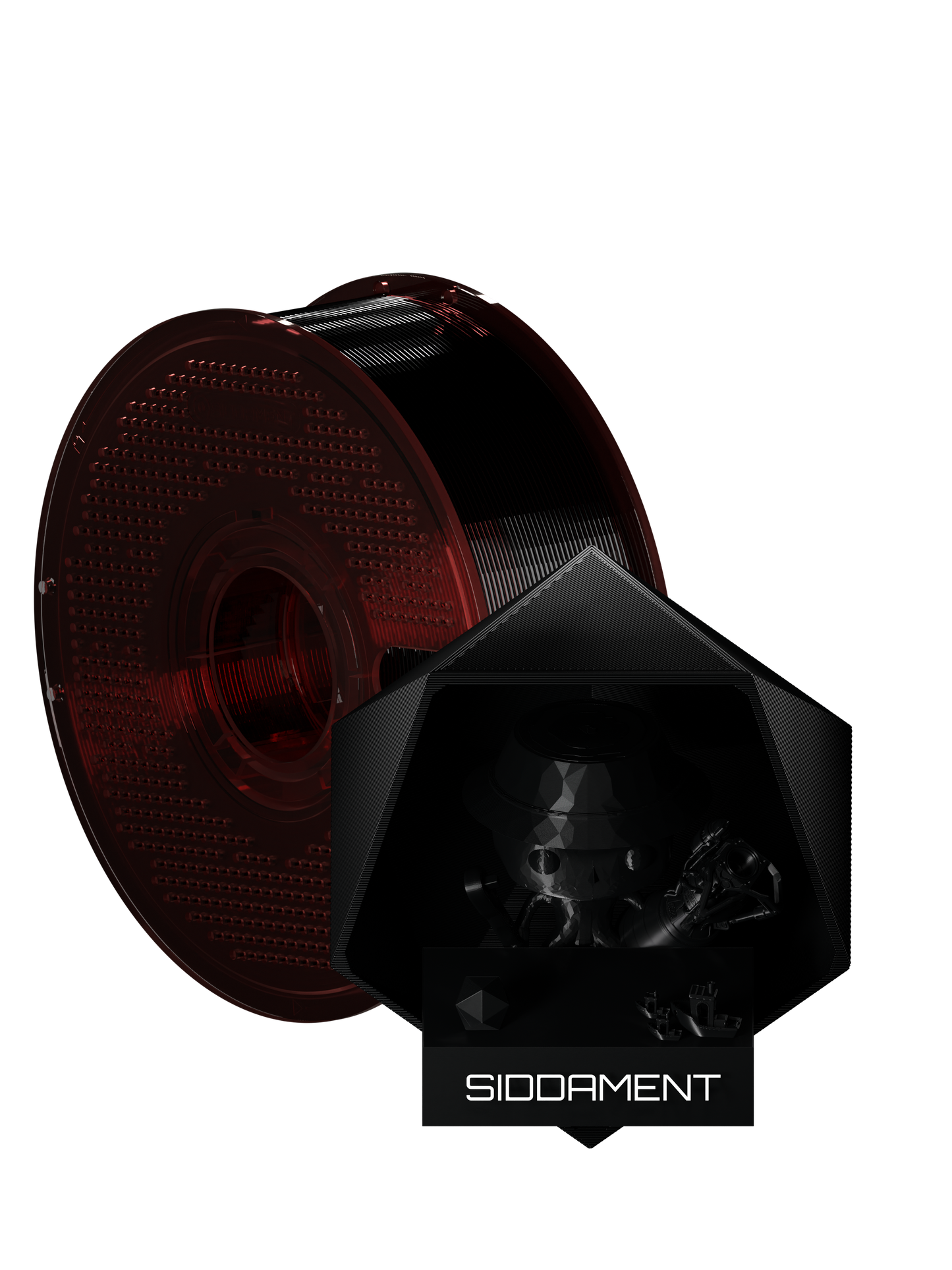
Siddament V2 SKU: 4.081
Black TPU 68D
Black TPU 68D
Out of Stock
Couldn't load pickup availability
Sidd's Shore 68D TPU — for when 95A is too soft. 68D on the Shore D scale (≈ 95–98 Shore A on the harder durometers) sits between flexible TPU and rigid engineering plastics. You get genuine impact resistance, abrasion resistance and chemical tolerance, but with semi-rigid stiffness that prints like a slightly bouncy nylon — not a rubber band.
What it's for
- Mechanical parts that flex but don't squish — gears, gripper jaws, knobs, latch hooks, bumpers
- Living hinges — survives more cycles than PLA/PETG hinges
- Industrial seals & gaskets where 95A would compress too far
- Cable strain reliefs, drone arms, RC parts — energy absorption without going floppy
- Phone cases & protective shells with a more premium, less rubbery feel
Why 68D over 95A
- ~3× stiffer — holds shape under load instead of bending
- Faster, easier prints — closer to PETG in print behaviour, less retraction tuning needed
- Better detail resolution on small features
- Direct drive recommended, but 68D is forgiving enough to print on a quality bowden setup
Recommended print settings
Hotend
220–240 °C
Heated Bed
50–60 °C
Print Speed
30–50 mm/s
Retraction
2–4 mm direct, 4–6 mm bowden
Cooling
30–50 % part fan
Bed adhesion
PEI / glass with glue stick — sticks well
Drying
50–60 °C for 8–10 h before printing if humidity-exposed
Diameter
1.75 mm
Net Weight
1 kg
Compatibility
Prints on any direct-drive 3D printer (Bambu, Voron, Prusa MK4/CORE One, Qidi, etc.). Bowden setups can run it slowly with extra retraction. Avoid extreme print speeds — TPU 68D handles much better than soft TPU but still benefits from controlled flow.
Storage
TPU is mildly hygroscopic. Store in a sealed dry box with desiccant. If prints become stringy or have a popping sound, dry at 50–60 °C for 8–10 hours and try again.
Sold by SIDDAMENT — fast Australian dispatch, AUD pricing.
Examples of enclosed printers: Bambu X1C / P1S, Prusa CORE One, Voron 2.4 / Trident, Qidi X-Plus, anything with sealed doors and a hot chamber.
Examples of open printers: Bambu A1 / A1 mini, Prusa MK4 / MINI, Ender 3, most bedslingers. These are fine for PLA / PETG / TPU / PVA but struggle with materials marked “Required” on this row — ABS, ASA, PC, Nylon and similar will warp or delaminate without a hot chamber.
* Depends on your dryer. If you’ve got a strong dryer (Sunlu S2/S4, PrintDry Pro, Eibos, etc.) 55 °C max is plenty. If your dryer is a weak boi (basic food dehydrator, cheap clip-on, fan-only) push it to 70 °C to actually move moisture out.