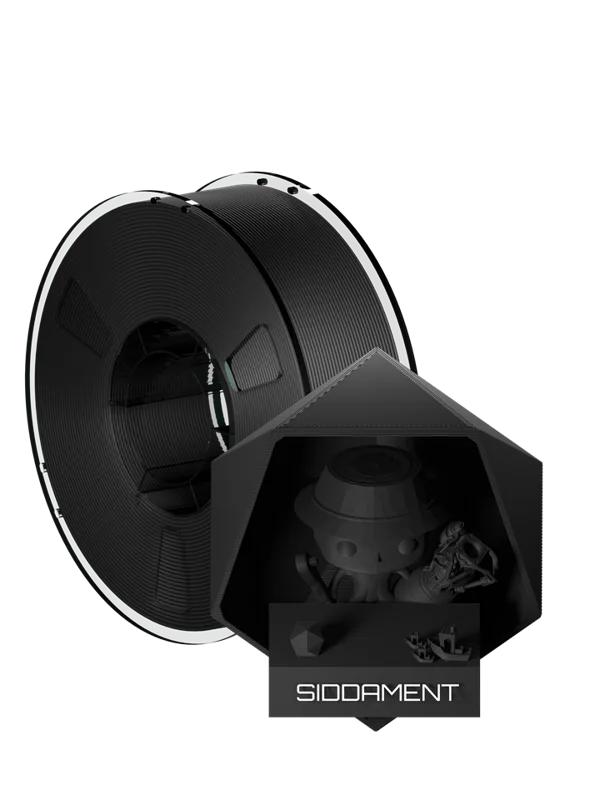
CNTRL P
CNTRL P PLA Filament | Australian Made | 1.75mm
CNTRL P PLA Filament | Australian Made | 1.75mm
Out of Stock
The everyday workhorse of the range. Easy to print, clean and reliable, in black and white at launch, tuned to run fast on modern printers without giving up quality at lower speeds.
Print at a glance
| Nozzle | 200 to 225 C |
|---|---|
| Bed | 55 to 60 C |
| Part cooling fan | 100 percent |
| Enclosure | Not required |
| Diameter | 1.75 mm, held to a tight tolerance window |
What sets it apart
Locally produced and checked at every step. The design goal is simple: the spool you load today and the spool you load in six months should behave identically on your printer.
Specifications
| Material | PLA |
|---|---|
| Brand | CNTRL P by Siddament |
| Diameter | 1.75 mm |
| Colours | Black, White |
| Made in | Sydney, Australia (filament extrusion) |
| Works with | Any printer that runs standard 1.75mm filament |
Extruded in Sydney
CNTRL P is a 3D printer filament brand made in Sydney. It is extruded, checked and dispatched in Australia by Siddament. The extrusion line, the quality checking and the dispatch are all in the same building.
A restock is a production run down the road, not a container crossing an ocean. Weeks rather than months.
Measured diameter on every spool
The diameter is measured on the line as the spool is wound, and that spool's own number is what you can look up. Not a figure copied off a datasheet. Look yours up on the check your spool page.
Common questions
Where is CNTRL P PLA made?
Sydney. The extrusion line, the quality checking and the dispatch are all in the same building.
What printers does CNTRL P PLA work with?
Any printer that runs standard 1.75mm filament. It also supports the open filament tag standard, so a compatible machine can read the spool and load the right settings for it.
Why only black and white?
Because they are the easiest colours to keep identical from run to run, and they cover most real work. Prove the process on the colours that hold best, then add the ones that are harder.
Can I get a custom colour?
Yes, and that is one of the real advantages of local extrusion. Bring a hex, a Pantone reference or a physical sample. See the custom colour page.
Is PLA filament good for beginners?
PLA filament is the usual starting point for a new 3D printer. PLA prints at low temperatures, does not need an enclosure and rarely warps, so most printers run it well on default settings. PLA is also available in more colours and finishes than any other material.
What temperature should I print PLA at?
Most PLA prints well with the nozzle between 190 and 220°C and the bed at 50 to 60°C. Silk and matte PLA often like the upper half of that nozzle range. Run the part cooling fan at full speed once the first layers are down.
Can PLA be used outdoors?
PLA is not a good outdoor material in Australia. PLA softens at about 55°C, which a part can reach in direct sun or inside a parked car, and it will sag or warp. ASA and PETG handle heat and weather far better than PLA.
More about the range on the CNTRL P page.
About PLA filament
PLA is the easiest 3D printer filament to print. It needs no enclosure, sticks to a bed at 50 to 60°C and holds fine detail.
What PLA is good for
PLA suits models, cosplay, toys, prototypes, jigs and anything that lives indoors. It is stiff and holds sharp detail. It softens at around 55°C, so it is the wrong choice for a part left in a hot car or in direct summer sun. For outdoor or warm parts look at PETG or ASA.
Browse all PLA filament or the full CNTRL P Australian made filament range.
Examples of enclosed printers: Bambu X1C / P1S, Prusa CORE One, Voron 2.4 / Trident, Qidi X-Plus, anything with sealed doors and a hot chamber.
Examples of open printers: Bambu A1 / A1 mini, Prusa MK4 / MINI, Ender 3, most bedslingers. These are fine for PLA / PETG / TPU / PVA but struggle with materials marked “Required” on this row — ABS, ASA, PC, Nylon and similar will warp or delaminate without a hot chamber.
* Depends on your dryer. If you’ve got a strong dryer (Sunlu S2/S4, PrintDry Pro, Eibos, etc.) 55 °C max is plenty. If your dryer is a weak boi (basic food dehydrator, cheap clip-on, fan-only) push it to 70 °C to actually move moisture out.