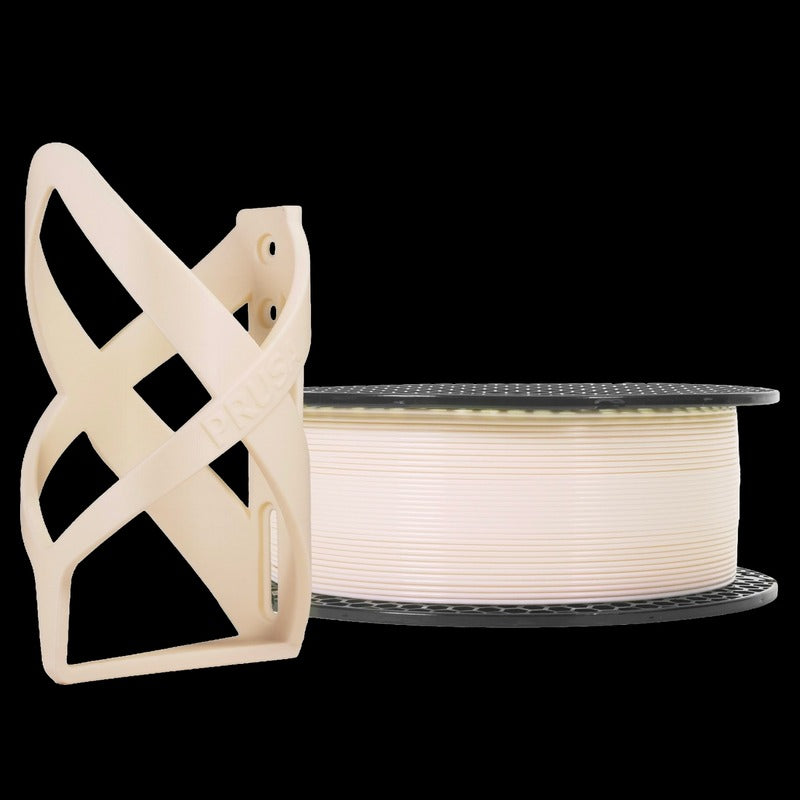
Prusa SKU: PRU.040
Prusament ASA Natural 800g (NFC) 1.75mm
Prusament ASA Natural 800g (NFC) 1.75mm
Discontinued
About ASA
ASA is a technical material with properties similar to ABS but better in several ways. Compared to ABS, it's UV stable, doesn't suffer from shrinking as badly, and produces much less noticeable fumes. ASA 3D prints are durable, tough and suitable for a wide range of applications. ASA has excellent high-temperature resistance — no signs of deformation up to 93 °C — making it especially suitable for objects meant for long-time outdoor use such as automotive parts, garden fixtures, signage, brackets and enclosures.
Prusament ASA is in-house made by Prusa Research with the manufacturing process closely monitored and tested, guaranteeing ±0.04 mm diameter precision and highly-consistent colours.
Printing setup
| Nozzle | 260 ± 5 °C |
| Heatbed | 110 ± 5 °C |
| Recommended steel sheet | Satin powder-coated |
| Recommended print speed | 40–60 mm/s |
| Diameter | 1.75 ± 0.04 mm |
| Net weight | ≥ 800 g |
| Heat deflection (HDT) | ~93 °C |
NFC + OpenPrintTag
Every new Prusament spool comes with a fully rewritable NFC tag powered by the OpenPrintTag standard. The tag holds essential filament data — material, colour, diameter, recommended print settings — and can be read with the Prusa mobile app or any compatible reader/printer that supports the open spec.
Why ASA over ABS
- UV-stable — doesn't yellow or chalk in sunlight.
- Lower warping than ABS, easier first layer.
- Reduced fumes — still recommended to print in an enclosure.
- Excellent layer adhesion — tough, ductile parts.
- Acetone-smoothable.
Examples of enclosed printers: Bambu X1C / P1S, Prusa CORE One, Voron 2.4 / Trident, Qidi X-Plus, anything with sealed doors and a hot chamber.
Examples of open printers: Bambu A1 / A1 mini, Prusa MK4 / MINI, Ender 3, most bedslingers. These are fine for PLA / PETG / TPU / PVA but struggle with materials marked “Required” on this row — ABS, ASA, PC, Nylon and similar will warp or delaminate without a hot chamber.
* Depends on your dryer. If you’ve got a strong dryer (Sunlu S2/S4, PrintDry Pro, Eibos, etc.) 55 °C max is plenty. If your dryer is a weak boi (basic food dehydrator, cheap clip-on, fan-only) push it to 70 °C to actually move moisture out.