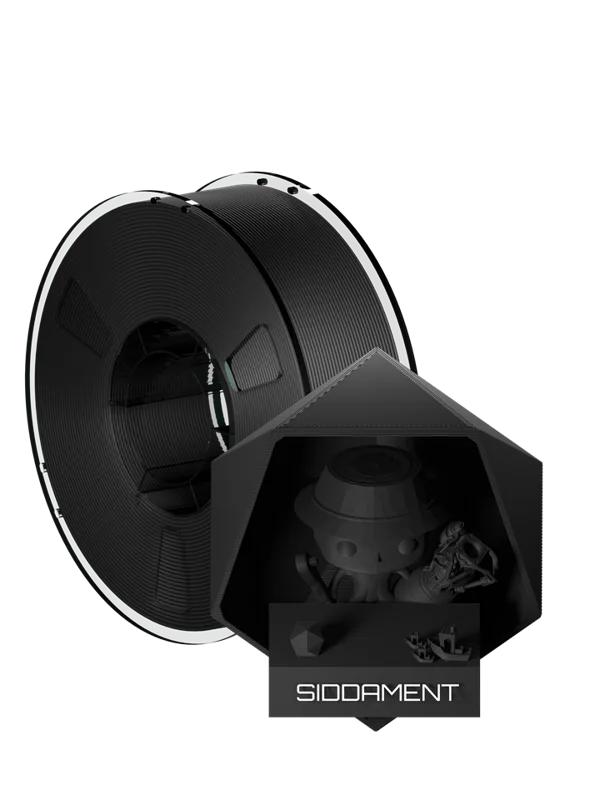
CNTRL P
CNTRL P ABS Filament | Australian Made | 1.75mm
CNTRL P ABS Filament | Australian Made | 1.75mm
Out of Stock
Engineering-grade, heat-tolerant ABS in black and white. The classic for indoor functional parts, tool housings and enclosures that face some heat.
What ABS is good for
- Indoor parts that face moderate heat (over 50 C)
- Tool housings and electronics enclosures
- Vapour-smoothable display pieces (acetone smoothing)
- Functional bricks and mechanical parts
Print at a glance
| Nozzle | 240 to 260 C |
|---|---|
| Bed | 95 to 110 C with glue stick or ABS slurry |
| Part cooling fan | Off or minimal |
| Enclosure | Strongly recommended |
| Diameter | 1.75 mm |
Specifications
| Material | ABS |
|---|---|
| Brand | CNTRL P by Siddament |
| Diameter | 1.75 mm |
| Colours | Black, White |
| Made in | Sydney, Australia (filament extrusion) |
| Works with | Any printer that runs standard 1.75mm filament |
Extruded in Sydney
CNTRL P is a 3D printer filament brand made in Sydney. It is extruded, checked and dispatched in Australia by Siddament. The extrusion line, the quality checking and the dispatch are all in the same building.
A restock is a production run down the road, not a container crossing an ocean. Weeks rather than months.
Measured diameter on every spool
The diameter is measured on the line as the spool is wound, and that spool's own number is what you can look up. Not a figure copied off a datasheet. Look yours up on the check your spool page.
Common questions
Where is CNTRL P ABS made?
Sydney. The extrusion line, the quality checking and the dispatch are all in the same building.
What printers does CNTRL P ABS work with?
Any printer that runs standard 1.75mm filament. It also supports the open filament tag standard, so a compatible machine can read the spool and load the right settings for it.
Why only black and white?
Because they are the easiest colours to keep identical from run to run, and they cover most real work. Prove the process on the colours that hold best, then add the ones that are harder.
Can I get a custom colour?
Yes, and that is one of the real advantages of local extrusion. Bring a hex, a Pantone reference or a physical sample. See the custom colour page.
Does ABS need an enclosure?
ABS prints far more reliably in an enclosure. ABS shrinks as it cools, and cold air on the part causes warping and cracks between layers. An enclosed printer keeps the air warm and still, which lets larger ABS parts finish without lifting off the bed.
What temperature should I print ABS at?
ABS usually prints with the nozzle at 240 to 260°C and the bed at 90 to 110°C. Keep the part cooling fan off or very low. Higher chamber temperatures improve layer bonding and reduce warping on bigger ABS parts.
What is the difference between ABS and ASA?
ABS and ASA print on very similar settings and have similar strength and heat resistance. The main difference is that ASA resists UV light and weather, so ASA keeps its colour and strength outdoors. ABS yellows and turns brittle in long term sun.
More about the range on the CNTRL P page.
About ABS filament
ABS is a strong, heat resistant 3D printer filament used for functional and mechanical parts. It holds its shape to around 100°C and can be sanded, glued and vapour smoothed. ABS needs a heated bed and an enclosure to avoid warping.
What ABS is good for
ABS suits printer parts, automotive interior parts, housings and brackets that sit near heat. It machines and sands well and takes acetone smoothing. ABS gives off fumes while printing, so print it in an enclosure with ventilation or filtration. For outdoor parts ASA prints much the same and adds UV resistance.
Browse all ABS filament or the full CNTRL P Australian made filament range.
Examples of enclosed printers: Bambu X1C / P1S, Prusa CORE One, Voron 2.4 / Trident, Qidi X-Plus, anything with sealed doors and a hot chamber.
Examples of open printers: Bambu A1 / A1 mini, Prusa MK4 / MINI, Ender 3, most bedslingers. These are fine for PLA / PETG / TPU / PVA but struggle with materials marked “Required” on this row — ABS, ASA, PC, Nylon and similar will warp or delaminate without a hot chamber.
* Depends on your dryer. If you’ve got a strong dryer (Sunlu S2/S4, PrintDry Pro, Eibos, etc.) 55 °C max is plenty. If your dryer is a weak boi (basic food dehydrator, cheap clip-on, fan-only) push it to 70 °C to actually move moisture out.